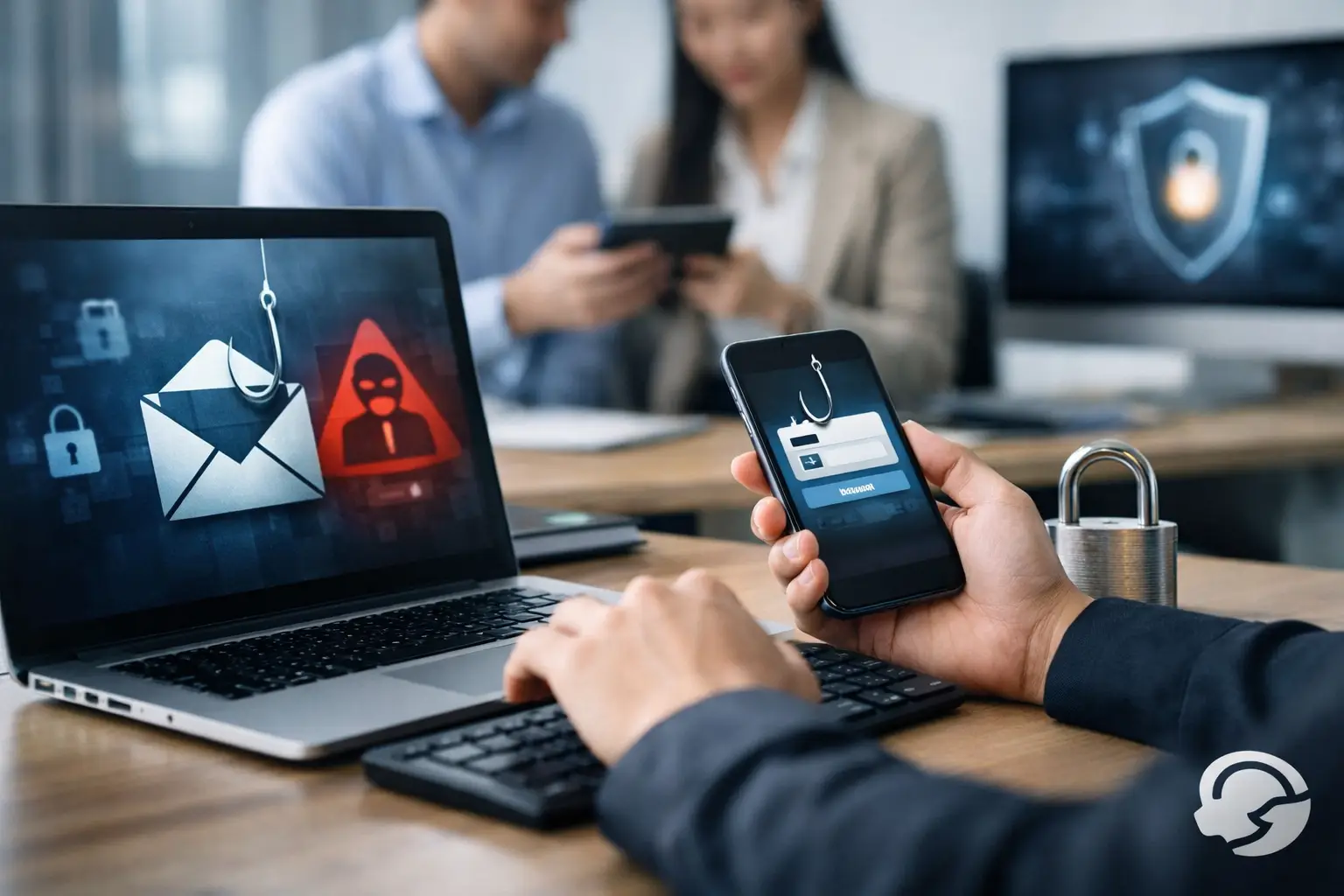
A fraudulent payment request rarely arrives looking fraudulent. It may appear to come from a CEO traveling between meetings, a trusted construction supplier changing banking details, a health plan administrator sharing a document, or a client asking for a revised invoice. To prevent phishing attacks, leaders must treat email and identity security as an operating discipline, not a one-time employee training exercise.
For organizations with 50 to 200 employees, phishing is a business process risk. It can interrupt payroll, redirect a wire transfer, expose regulated data, compromise a customer relationship, or create difficult questions during an insurance renewal or enterprise security review. Protection is the baseline. Growth is the objective.
Why phishing remains an executive-level risk
Phishing succeeds because it targets normal behavior: urgency, trust, routine approvals, and the pressure to keep work moving. Attackers no longer rely only on poorly written messages or obvious attachments. They impersonate vendors, executives, banks, software platforms, and even internal departments. They research public information, reuse language from legitimate communications, and take advantage of weak identity controls.
The resulting risk extends beyond an employee clicking a link. A compromised mailbox can be used to monitor conversations, identify payment cycles, and send convincing messages from a real account. This is the foundation of many business email compromise incidents, where the apparent legitimacy of the request matters more than technical sophistication.
For a professional-services firm, the consequence may be disclosure of sensitive client records. For a healthcare practice, it may involve protected health information and a disruption to patient operations. For a contractor, it can mean altered payment instructions, exposed bid documents, or a compromised project manager’s account during a critical phase of work.
The strategic issue is trust. Clients, carriers, lenders, and larger partners increasingly expect evidence that a business can protect communications and respond responsibly when something goes wrong. Cyber maturity builds trust. Trust opens markets.
Prevent phishing attacks with a layered operating model
There is no single tool that prevents every phishing attempt. Effective protection combines technology, policy, verification, and practiced decision-making. The right balance depends on your industry, the sensitivity of your data, the volume of payments, and how distributed your workforce is.
Start with identity, not just the inbox
Email filtering remains necessary, but identity security is often the more decisive control. If an attacker obtains an employee’s password, a weakly protected account can give them the ability to read mail, reset other credentials, and impersonate that user internally.
Require multi-factor authentication for email, cloud applications, remote access, administrative accounts, and finance systems. Where possible, use phishing-resistant methods rather than relying exclusively on text-message codes. Apply conditional access policies that evaluate the user, device, location, and risk level before granting access.
This is where Zero Trust becomes practical rather than theoretical. A familiar username and password should not automatically equal trust. Access should be continuously evaluated, particularly for executives, finance personnel, administrators, and employees handling patient, financial, or client information.
Protect email at the domain and message level
A business should be able to verify that messages claiming to originate from its domain are legitimate. Domain-based email authentication helps reduce impersonation and protects the company’s reputation when properly configured and monitored.
Advanced email security should also inspect links, attachments, sender behavior, and unusual message patterns. It can quarantine suspicious messages before they reach the user and flag communications that require additional scrutiny. Yet filtering has limits. A message from a compromised vendor account may pass technical checks because the sender is real.
That is why email protection must be paired with clear verification procedures. The most sensitive requests should never depend on email alone.
Separate communication from authorization
Wire transfers, payroll changes, vendor banking updates, gift-card requests, and requests for confidential files deserve a formal verification step. A reply to the same email thread is not sufficient verification if the mailbox may be compromised.
Establish a documented process that requires an independent confirmation method, such as a call to a known phone number or an approval within a controlled financial workflow. Finance teams should be empowered to pause a request that breaks process, even when it appears to come from a senior executive.
This is a leadership issue as much as a finance issue. If executives regularly send urgent, exception-based requests by text or email, they unintentionally train employees to bypass controls. The strongest policy fails when senior leaders model the opposite behavior.
Make awareness training specific to real work
Annual compliance training alone does not create better decisions under pressure. Employees need short, recurring practice based on the situations they actually encounter: supplier invoices, shared-document notices, password-reset requests, HR forms, mobile messages, and executive impersonation.
Training should explain what to do, not simply what to fear. Employees need a simple reporting path, confidence that reporting quickly is valued, and feedback when a suspicious message is confirmed. Simulated phishing exercises can be useful when they are framed as coaching rather than public scorekeeping.
Measure more than click rates. Consider reporting rates, repeat patterns by department, response times, and whether high-risk teams understand the verification process. A firm with strong reporting behavior may identify and contain a threat before it reaches a material business decision.
Build a phishing response plan before you need it
The first minutes after a suspected phishing incident matter. An employee who reports a message quickly can prevent a contained event from becoming an account takeover or payment fraud loss. But speed requires clarity.
Your incident process should define who receives reports, who can disable sessions or reset credentials, who investigates mailbox rules and forwarding settings, and who communicates with affected clients or vendors when necessary. It should also account for business continuity. If a finance leader’s account is under investigation near payroll processing, the organization needs an alternate approval path that preserves control without stopping operations.
A mature response includes technical containment, evidence preservation, leadership communication, and lessons learned. It also distinguishes between a suspicious email that was merely received, a link that was clicked, credentials that were entered, and an account that was actually accessed. Each scenario calls for a different level of action.
Continuous monitoring through security operations capabilities can reduce the time between a warning signal and a coordinated response. For organizations without a dedicated internal security team, this is often where a managed cybersecurity partner creates material value: not by selling alarm, but by providing accountable visibility and practiced action.
Focus protection where the business is most exposed
Not every user carries the same level of risk. Executives, executive assistants, finance teams, HR, IT administrators, and employees who work with regulated records or client funds should receive controls tailored to their roles.
Executives deserve particular attention because their accounts are high-value targets and their travel, public visibility, and mobile-device use can increase exposure. Executive mobile security and risk intelligence can help identify risky access patterns, while secure authentication and device management reduce the chance that a single lost credential becomes a broader compromise.
For healthcare, financial services, legal, and insurance organizations, phishing controls should connect to privacy obligations, audit readiness, and documented incident procedures. For construction and distributed operations, controls should account for job-site connectivity, vendor communication, mobile workflows, and payment-change fraud. The principle is the same, but the operating model should reflect the work.
Turn phishing resilience into a business advantage
The question is not whether your organization receives phishing messages. It does. The question is whether your people, processes, and technology can recognize the attempt, limit access, verify sensitive requests, and recover without creating unnecessary disruption.
CMIT Solutions of LA approaches this challenge through integrated cybersecurity architecture, including Zero Trust protection, email security, security awareness training, continuous monitoring, and compliance-aligned operating practices. In a framework such as CyberSuite 1.9.4.26, phishing defense is not an isolated toolset. It is part of how an organization demonstrates operational maturity across identities, endpoints, communications, and response.
Leadership teams should review phishing resilience with the same seriousness they apply to cash controls, contractual obligations, and continuity planning. Ask whether payment verification is consistently followed, whether privileged accounts have stronger safeguards, whether employees report concerns without hesitation, and whether the organization can prove its controls to a demanding client or auditor.
A business that can answer those questions with confidence is doing more than reducing exposure. It is becoming easier to trust, easier to onboard, and better positioned to pursue the next opportunity.