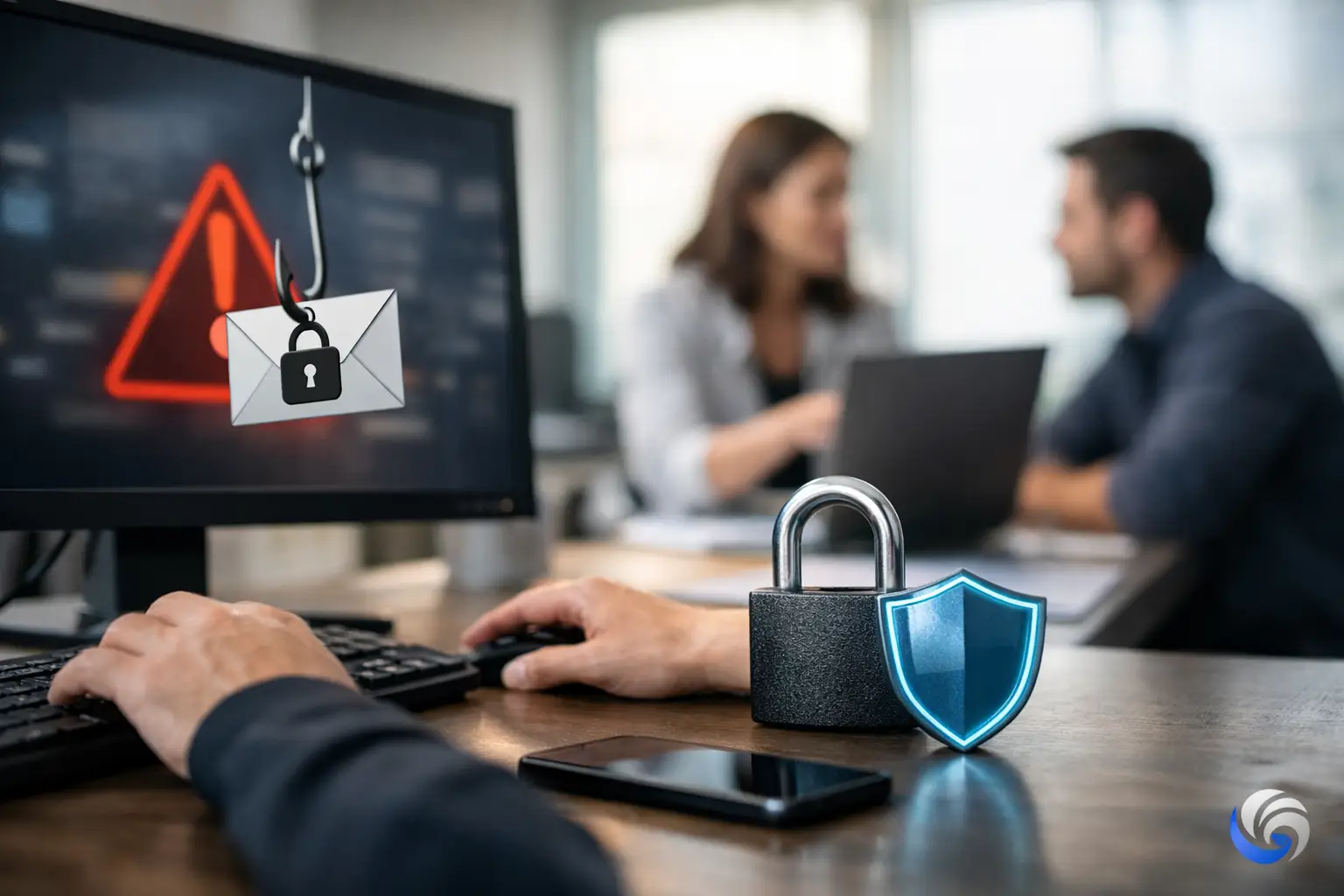
A single convincing email can bypass years of good intentions. It may appear to come from a client, a vendor, a senior executive, or Microsoft 365. It may request an invoice update, a password reset, or a quick review of a shared document. For growing businesses, the best ways to prevent phishing attacks are not limited to telling employees to be careful. They require a disciplined system of people, technology, and leadership accountability.
Phishing is no longer a low-effort nuisance. Criminal groups study company websites, public job postings, social media activity, vendor relationships, and executive travel schedules. Their goal is not always to infect a device. Often, they want a credential, a wire transfer, a change in payment instructions, or access to sensitive client information. That makes phishing prevention a business continuity and market-readiness issue, not simply an IT task.
Why Phishing Remains a Board-Level Business Risk
Most breaches begin with an identity compromise. When an employee enters credentials into a fraudulent login page, attackers can gain access to email, cloud files, financial systems, and internal conversations without breaking through a firewall. From there, they can impersonate leadership, target customers, or identify the right moment to initiate a fraudulent payment request.
For professional services firms, legal practices, manufacturers, and government-adjacent contractors, the damage extends beyond immediate financial loss. A phishing incident can interrupt operations, expose protected data, trigger contractual notification obligations, and weaken trust with larger clients. If your organization is pursuing enterprise accounts or regulated opportunities, security maturity is part of your credibility.
The strongest posture recognizes a simple reality: employees will occasionally receive deceptive messages, and some will be exceptionally convincing. The goal is to make one mistaken click far less likely to become a material business event.
Best Ways to Prevent Phishing Attacks Across the Business
Make identity protection non-negotiable
Multi-factor authentication is one of the highest-value controls a business can deploy. A stolen password should not be enough for an attacker to enter an account. However, not all multi-factor authentication methods offer the same protection. Text-message codes are better than passwords alone, but they can be vulnerable to SIM swapping and real-time phishing kits.
For higher-risk users, especially executives, finance personnel, administrators, and anyone with access to sensitive client data, phishing-resistant methods such as authenticator apps with number matching, hardware security keys, or passkeys offer a stronger layer of defense. The appropriate choice depends on your environment and workforce, but the principle is clear: protect the identities attackers want most.
Also eliminate shared accounts wherever possible. Shared credentials erase accountability and create an unnecessary opening when employees change roles or leave the company. Every user should have only the access required for their responsibilities, and elevated administrative access should be tightly controlled.
Turn awareness training into decision training
Annual compliance videos do not create reliable human defenses. Employees need practical context that reflects the messages they actually receive: fake document-sharing notices, executive impersonation, benefits updates, invoice requests, and messages that exploit urgency or authority.
Effective phishing training is short, recurring, and role-specific. Finance teams should practice recognizing payment-change fraud. Human resources teams should understand payroll and employee-data scams. Executives and assistants should be prepared for targeted spear-phishing attempts that reference real meetings, clients, or travel.
Simulated phishing campaigns can help, but they should not become a public test designed to embarrass employees. The point is to identify patterns, reinforce judgment, and improve reporting behavior. A company that punishes every mistake may drive people to hide incidents. A company that treats reporting as a professional responsibility sees threats earlier.
Employees should know to pause when a message creates urgency, requests credentials, changes bank details, or asks them to bypass a normal approval process. They should also have a simple way to report suspicious messages. Fast reporting lets IT teams remove similar emails from other inboxes before the attack spreads.
Secure email before it reaches the inbox
Email security must do more than filter obvious spam. Modern protection should inspect links, attachments, sender behavior, and message context. It should flag unusual external messages, quarantine suspicious content, and prevent employees from opening known malicious destinations.
Domain protection also matters. SPF, DKIM, and DMARC help receiving mail systems verify whether messages claiming to come from your domain are legitimate. These controls reduce the risk that criminals will spoof your company to deceive customers, vendors, or employees.
DMARC requires careful implementation. An aggressive enforcement policy can affect legitimate third-party senders if it is configured without a full understanding of the systems sending email on your behalf. Start by identifying authorized senders, monitoring results, and moving toward enforcement with a clear plan. Security controls should reduce risk without disrupting revenue-generating communication.
Create verification rules for money and sensitive data
Phishing succeeds when an email alone can authorize a consequential action. That should never be the case for wire transfers, payroll changes, new vendor bank details, or the release of confidential information.
Establish an out-of-band verification process. If a vendor emails new payment instructions, confirm the request using a known phone number from your vendor records, not a number included in the email. If an executive requests an urgent transfer, require a second approver and verify through an established communication channel.
These procedures may feel slower than an email reply, particularly in fast-moving organizations. That is the trade-off. A two-minute verification step is far less costly than recovering funds from a fraudulent transfer or explaining a data breach to a major client.
Reduce the blast radius of a successful click
No organization can promise that nobody will ever click a malicious link. Mature cybersecurity planning assumes that incidents can happen and limits what an attacker can do next.
Endpoint detection and response tools can identify suspicious activity on laptops and servers. Segmented networks can prevent a compromised device from freely reaching critical systems. Regular patching closes vulnerabilities that attackers use after gaining access. Encrypted, tested backups provide a recovery path if phishing leads to ransomware.
Most importantly, maintain a clear incident response process. Employees need to know exactly what to do if they enter credentials, open an attachment, or approve a suspicious sign-in prompt. Speed matters. Prompt password resets, session revocation, device investigation, and mailbox review can stop an account takeover before it becomes a wider compromise.
Executive Leadership Sets the Security Standard
Phishing prevention fails when it is assigned entirely to the help desk. Leaders establish whether security controls are viewed as obstacles or as the operating discipline that protects clients, cash flow, and growth plans.
Executives should receive regular reporting on phishing trends, failed login attempts, multi-factor authentication coverage, training participation, and simulated phishing results. More importantly, they should ask whether the business can verify sensitive requests, recover from an account compromise, and meet the security expectations of its most demanding customers.
This is where cybersecurity becomes a growth asset. Strong email security, identity controls, documented procedures, and tested recovery capabilities can help an organization pass vendor assessments, meet contractual obligations, and compete for larger opportunities. Security is not separate from market access. It is increasingly a condition of it.
CMIT Solutions of LA helps organizations build this kind of layered posture through strategic oversight, security controls, user education, and continuity planning. The objective is not to create friction for its own sake. It is to create an environment where employees can move decisively because the business has designed safeguards around high-risk actions.
A phishing-resistant organization is built in everyday decisions: how access is granted, how payments are approved, how employees report concerns, and how quickly the company responds when something looks wrong. Treat those decisions as part of operational maturity, and security becomes one more reason clients can trust you with larger, more valuable work.